 Saskia Teichmann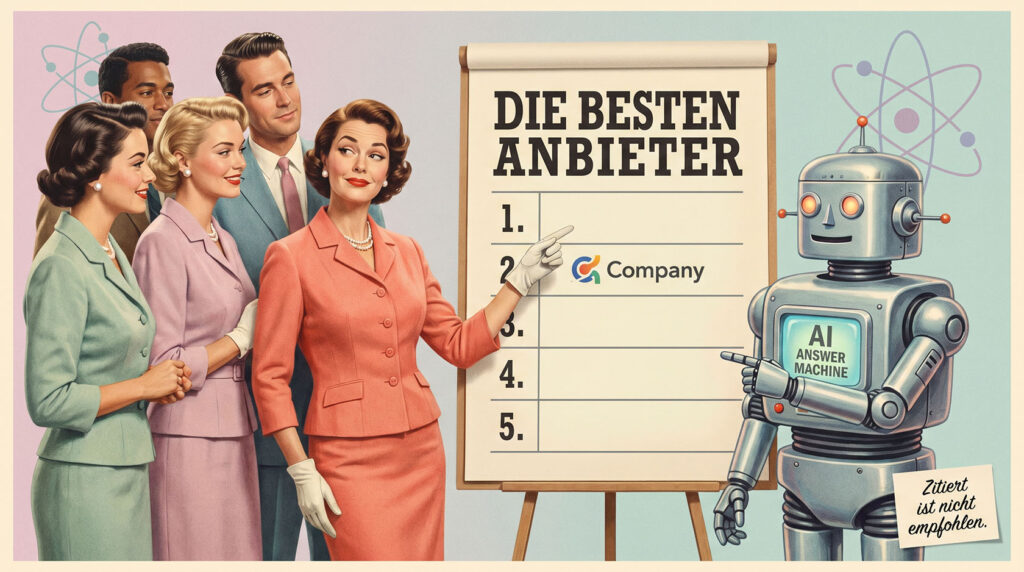
As of June 2026. Listicles are once again the talk of the town in the SEO and AI visibility bubble. You know, those „Top 10 Tools for …“ articles that pretend to offer a neutral comparison, while the company publishing them consistently ranks itself at number one. Who would’ve guessed?.
In the U.S. market, this is old news. In the DACH region, however, it seems like a fresh GEO discovery to many right now. But what’s interesting isn’t that such lists exist. What’s interesting is that AI Search Is Changing the Rules of the Game: A comparison list can be cited without recommending the brand that published it.
The Summary
- Listicles are structured comparison lists: „Best Tools,“ „Top Providers,“ „Alternatives to …,“ „Software Comparison.“.
- AI systems use such pages as input for recommendations: especially for commercial, comparative, and early-stage research questions.
- But a citation is not the same as a recommendation: One page can serve as a source, while the AI response recommends other brands.
- Self-promoting rankings are becoming riskier: Anyone who places themselves in first place and lists competitors below them may be providing the AI with a neatly sorted list of competitors.
- Good comparison sites are still useful: when criteria, methodology, conflicts of interest, data, and limitations are transparent.
My recommendation: Don't treat comparison lists as a GEO trick, but rather as an editorial responsibility. If a list doesn't help a real person, you shouldn't expect it to work wonders in AI Search of all places in the long run.
What are listicles?
Listicles are articles that present information in the form of a list or ranking. In the context of SEO, these are often posts like „The Best CRM Systems of 2026,“ „Top 10 WordPress Plugins for …,“ or „The Best Agencies for ….“ The format is popular because people like to compare options before making decisions.
The problem arises when the list pretends to be a neutral comparison but is actually just a landing page with rankings. Self-promotional “listicles” are particularly problematic: a company publishes a list of the best providers on its own website and puts itself in first place.
People can often see right through this. It could still work for traditional search, though. For AI Search, it gets more complicated because systems don’t just read such pages as ranking pages, but as structured sources of information about a category, its key players, and their relationships.
Why AI Systems Like Comparison Lists
AI response systems must construct a concise answer from many sources. For questions like „Which project management tools are suitable for small teams?“ or „What is the best alternative to [product]?“, comparison lists are convenient: they include names, categories, pros and cons, prices, target audiences, and sometimes tables.
In May 2026, Peec AI analyzed nearly 200,000 AI responses and 5.7 million data points across eight AI engines. The study shows that when AI systems frequently cite certain third-party listicles, a brand’s ranking within those lists is significantly correlated with whether and where it appears in AI responses.
AirOps describes a similar trend: In early commercial searches, many brand mentions do not come from the company’s own website, but from external comparison, review, and list sites. This makes sense. People who don’t yet have a specific brand in mind search by category. Systems then look for sources that organize results by category.
A citation is not a recommendation
That’s the most important point. Many AI visibility dashboards track whether a URL is cited. That’s useful, but it’s not enough. A source may appear in an AI response and still not strengthen the brand that published it.
In June 2026, Lily Ray used 100 B2B „best [category]“ queries in Google AI Overviews to demonstrate just how problematic this discrepancy can be: Self-promotional listicles were used as sources, while the company’s own brand was missing from the actual recommendation. Instead, competitors who were also mentioned in that very list were recommended.
In other words, your own website can become supporting evidence for recommendations made by others. In that case, citing it is not recommended. For reporting purposes, this is a small but important blow to one’s ego.
The Risk of Self-Promoting Rankings
Why does this happen? Because a self-promoting list isn't automatically credible. If an unknown brand ranks itself at number 1, an AI system can use that page as a structured category source, but it will derive its recommendation from stronger external signals: well-known competitors, frequent mentions, backlinks, community discussions, reviews, videos, industry lists, or other third-party sources.
The combination of a weak brand and a highly structured list of competitors is particularly dangerous. You’re essentially telling the algorithm very clearly, „Here are all the relevant providers in my category.“ But it doesn’t necessarily believe you when you say you’re the best choice.
Added to this is Google’s spam framework. Google now explicitly mentions attempts to manipulate generative AI responses in Google Search. Scaled, interchangeable comparison sites with no real user value can also quickly slide into “scaled content abuse.” This doesn’t have to apply to every comparison site, but it sets a clear boundary: Don’t create a list just so a machine can process it.
Why Third-Party Sources Are So Important
For AI Visibility, a company’s own website is just one source among many. Especially when it comes to open-ended recommendation questions, systems want to know whether a brand appears outside of its own website. Third-party sources serve as a form of social and technical validation: reviews, comparison sites, industry lists, GitHub, YouTube, Reddit, technical articles, podcasts, conferences, marketplaces, and directories.
That doesn't mean you should go out and artificially buy mentions everywhere. On the contrary. The more effective AI systems become at detecting manipulative patterns, the more valuable genuine evidence becomes: verifiable user experiences, independent mentions, reliable product data, transparent documentation, good examples, and clear positioning.
This is particularly interesting for the DACH region. Many B2B providers do good work but lack strong public evidence. They have clients, projects, and expertise, but hardly any third-party sources that are easily discoverable. It’s not necessarily that they’re missing a listicle; rather, they lack public evidence.
What a Good Comparison Site Needs
Comparison sites aren't necessarily bad. A good comparison site can be extremely helpful if it addresses a real decision-making issue. The difference lies in the methodology.
- Clear criteria: What criteria are used for comparison?
- Transparent Selection: Why are these specific providers on the list?
- Disclosed Interests: Are there any affiliate links, partnerships, proprietary products, or other conflicts of interest?
- Current data: Prices, features, availability, target audiences, and restrictions must be maintained.
- Supporting documents: Screenshots, tests, documentation, user feedback, public sources, or verifiable experience.
- Honest Boundaries: Who is a provider suitable for, and who is it not suitable for?
- No false neutrality: If you're comparing your own product, be upfront about it.
A good comparison site is allowed to have an opinion. It’s even allowed to explain its own product. But it shouldn’t pretend that self-praise is an independent ranking.
What This Means for WordPress
For WordPress websites, this means: Don’t create comparison content as mass-produced SEO content. A single, well-written comparison page can be useful if it’s truly helpful. Twenty thin „Best Providers in City X“ pages, on the other hand, are more of a red flag.
From a technical standpoint, you should handle comparison sites properly: clear headings, proper tables, well-maintained revision history, visible authors, traceable sources, consistent product names, internal links to detail pages, and appropriate structured data—provided it accurately describes the visible content.
The basics of this are directly related to the previous article: Schema, Entities, and Citable Content. A comparison list doesn't get any better just because it follows a schema. But if it's well-structured, clean markup can help link providers, products, authors, and sources more clearly.
My Thoughts on citelayer®
In the citelayer® AI Visibility Audit-From this perspective, a listicle mention is never automatically a success. The key questions are: Is the brand being recommended? In what context? Alongside which competitors? From which sources? And is the source truly helpful, or is it just another self-referential SEO attempt?
citelayer® for WordPress can help with technical readability: machine-readable outputs, llms.txt, Markdown, schema context, and content signals. But the editorial question remains a human one: Is this comparison honest enough that you’d show it to a client right there at the table?
Practical Checklist
- Check the intent: Is this page meant to help you make a decision, or is it just meant to manipulate an AI response?
- Separate "Citation" and "Recommendation": Don't just look at sources, but also at which brands are actually recommended.
- Document criteria: Features, Target Audience, Price, Support, Privacy, Integrations, Limitations.
- Disclose any conflicts of interest: Our own products, affiliate programs, partnerships, and sponsorships.
- Care Updates: Comparison sites become outdated faster than regular guidebooks.
- Number of supporting documents: Focus on genuine mentions, reviews, documentation, and community signals rather than fake rankings.
- Avoid list spam: No scaled-down versions without real added value.
- Test AI responses regularly: Which source is cited, which brand is recommended, and which competitors are mentioned?
FAQ
Are listicles bad for SEO or AI visibility?
No, not across the board. Poorly curated, self-promotional, or scaled-down lists are risky. Good comparison sites with clear methodologies and genuine value can still be useful.
Should I mention my own product in a comparison list?
Yes, if it's relevant and you disclose that it's your own product. It becomes problematic when you publish a seemingly neutral list and rank yourself number one without any solid criteria.
Which is more important: being on a list or being at the top of it?
Both can be important, but it depends on the source, industry, and AI system. Peec AI data shows that rankings in frequently cited third-party lists may be correlated with AI response rankings. Nevertheless, no single list is a guarantee.
Why can having your own list help competitors?
Because this provides the AI with a structured overview of your competitors. If your brand ranks lower than the competition outside of this list, the system may mention your site but recommend the stronger competitors.
How do I measure whether a listicle strategy is working?
Check several things separately: Is your site cited? Is your brand mentioned? Is it recommended? In what position? Which competitors appear? Which third-party sources shape the answer? A single citation score isn't enough.
Sources and Verification
This article is based on public studies, Google documentation, and my own work on citelayer® products and audits. My own observations are presented as expert analysis; public factual claims can be verified using the following sources.
- Peec AI: The Listicle Rank Effect: https://peec.ai/blog/the-listicle-rank-effect-what-nearly-200-000-ai-responses-across-8-ai-engines-reveal-about-brand-visibility
- Lily Ray: Why Calling Yourself the Best Could Be Helping Your Competitors Win in AI Search: https://lilyraynyc.substack.com/p/why-calling-yourself-the-best-could
- Lily Ray: Is Google Finally Cracking Down on Self-Promotional Listicles?: https://lilyraynyc.substack.com/p/is-google-finally-cracking-down-on
- Seer Interactive: The Window for Listicles Is Closing in AI Search: https://www.seerinteractive.com/insights/the-listicle-window-is-closing-in-ai-search-30-decline-mom
- AirOps: The State of AI Search in 2026: https://www.airops.com/report/the-2026-state-of-ai-search
- Google Search Central: Spam policies for Google Web Search: https://developers.google.com/search/docs/essentials/spam-policies
- Google Search Central: Optimizing Your Website for Generative AI Features on Google Search: https://developers.google.com/search/docs/fundamentals/ai-optimization-guide
- citelayer® WordPress Plugin: https://citelayer.ai/
- citelayer® AI Visibility Audit: https://citelayer-ai.com/services/ai-visibility-audit/





Discussion on the post
0 comments