

Accessibility is no longer just a „nice to have.“ It determines whether people can use your content at all—and it increasingly determines how search engines rank your website.
With the Barrier-Free Accessibility Act (BFSG) the legislator has now moved the issue to where it belongs: into the standard checklist for digital products, websites, and online shops. At the latest since the June 28, 2025 Certain products and services must be provided in an accessible manner. This also includes Electronic commerce services – in other words, precisely those online offerings through which consumers conclude contracts, purchase products, or book services. (Laws on the Internet)
This article is about,
- what that BFSG 2025 actually regulates,
- whether your Website or your online shop from BFSG affected,
- how you implement the requirements in practice,
- and why accessibility is not only beneficial from a legal standpoint, but also for your ranking and conversion.
1. What is behind the Accessibility Enhancement Act (BFSG)?
The BFSG implements European Directive (EU) 2019/882, known as the European Accessibility Act, into German law. The aim is to harmonize accessibility requirements for certain products and services across Europe and enable people with disabilities to participate on an equal basis. (Laws on the Internet)
Section 1 of the BFSG states, in brief:
The purpose of the Act is to ensure the accessibility of certain products and services in the interests of consumers and users. (Laws on the Internet)
Important for your planning:
- The law was passed in 2021 and
- is to June 28, 2025 fully entered into force. (Social Association VdK Germany e.V.)
The specific technical requirements for accessibility are set out in the Ordinance on the BFSG (BFSGV) regulated. It is based, among other things, on the European standard EN 301 549 and thus on the Web Content Accessibility Guidelines (WCAG 2.1, Level AA). (Laws on the Internet)
2. Who does the BFSG 2025 apply to—am I affected as a website operator?
The central question that many people ask themselves is essentially:
„Is my website affected by the BFSG?“
The answer does not depend on whether you „have a website,“ but rather on what you do there. The law lists a range of products and services—from banking services to e-books to Electronic commerce services. (Federal Agency for Accessibility)
2.1 BFSG and „electronic commerce services“
The term „electronic commerce services“ is defined in the BFSG (Section 2 No. 26 BFSG) and is clearly explained by the Federal Accessibility Agency: It refers to services where consumers conclude a contract online—for example, through a purchase, booking, or order. (Federal Agency for Accessibility)
Typical examples:
- online stores, where customers add products to their shopping cart, place orders, and make payments.,
- Websites with online appointment booking, if the booking directly leads to a paid contract (e.g., doctor's office, hairdresser, coaching, course booking),
- Portals through which Tickets, subscriptions, or digital services be booked,
- Platforms on which consumers conclude contracts with third parties.
If you recognize yourself in these examples, you are operating in the core area of „BFSG online shop / BFSG website in electronic commerce“.
2.2 Purely informative websites vs. BFSG obligation
Not every website is automatically a „BFSG website“ within the meaning of the law:
- pure information services, where you explain your services, show references, and provide contact details, but no immediate online contract conclusion are often classified differently by specialist agencies than traditional e-commerce or booking platforms. (Federal Agency for Accessibility)
- Nevertheless, digital accessibility makes sense here too—from the perspective of user experience, SEO, and brand image.
In short:
- Yes, the BFSG 2025 affects many online shops and booking channels.
- No, not every simple company website automatically falls under the BFSG obligations.
2.3 BFSG & micro-enterprises: the exceptions
You are wondering whether you fall under the so-called „BFSG Microenterprise Exception“ fall? Rightly so, because many smaller businesses fall precisely into this category.
As microenterprise apply to companies with (Federal Government.de)
- fewer than 10 employees and
- maximum annual turnover or annual balance sheet total of EUR 2 million.
The following applies to these companies:
- Do they provide services, accessibility according to BFSG generally voluntary – they are therefore not subject to the obligation to provide barrier-free services. (Federal Government.de)
- However, please note products or place products on the market that fall within the scope of the BFSG (e.g., certain end devices or e-books), the requirements apply. despite being a microenterprise. (Federal Government.de)
It is also important to note that: B2B offers, According to various specialist sources, offers that are aimed exclusively at businesses are not covered by the BFSG. The decisive factor is that it is clear that these offers are not intended for consumers. (BFSG)
3. When do the requirements come into effect—and what are the penalties for noncompliance?
With a few exceptions, the BFSG is June 28, 2025 effective. From this date onwards, the products and services covered must meet the legally defined accessibility requirements. There are transitional arrangements for certain situations, such as products already on the market. (Social Association VdK Germany e.V.)
3.1 BFSG Fine of up to €100,000
If accessibility requirements are not met when offering products or services, the competent market surveillance authorities can take measures ranging from requesting rectification to prohibiting the offer. In serious cases, there is a risk of Fines of up to €100,000, as explained in various legal articles. (White & Partner Esslingen)
In addition to administrative procedures, you should not underestimate the reputational effects: Those who demonstrably exclude people lose trust. – among users as well as partners, the media, and potential employees.
4. What does „barrier-free“ mean specifically for websites and online shops?
The BFSGV specifies what accessibility means for the products and services concerned. For services in electronic commerce, these are in particular: (Laws on the Internet)
- which general requirements for services (Section 12 BFSGV),
- additional requirements for certain services (Section 13 BFSGV) and
- the special requirements for Electronic commerce services (Section 19 BFSGV)
relevant.
In practice, this means that for a BFSG website / BFSG online shop among others:
- Information must
- understandably,
- perceptible through different senses (e.g., text instead of pure pictorial writing),
- and robustly deployed. (Laws on the Internet)
- The user interface must be designed in such a way that it can be used by people with different disabilities – keyword Keyboard operability, focus guidance, helpful error messages. (Laws on the Internet)
- Assistive technologies (e.g., screen readers) must be able to handle content in a meaningful way—this requires Clean HTML structures and semantic markup ahead.
Many of these requirements overlap with what you already know from technical search engine optimization: structured content, clear semantic levels, stable layouts, and good performance. For example, the article provides a detailed overview of these overlaps. „Technical SEO 2024: Comprehensive Guide to Website Optimization“ on my page:
https://isla-stud.io/ratgeber/technische-seo-leitfaden-2024/ (saskialund.de)
5. Practical requirements: BFSG website & BFSG online shop
To make it more concrete, here are some key points that can be derived from the BFSG, BFSGV, and the WCAG basic principles:
5.1 Structure & Navigation
- Headings follow a logical hierarchy (H1–H2–H3).
- Navigation areas are defined as
excellent, the main content as. - The focus (i.e., the targeted element) is visible/highlighted when you operate your website using only the keyboard.
5.2 Forms & Checkout
The checkout is where it's decided whether your online store barrier-free is:
- Each form field has a correctly linked label.
- Error messages are understandable and are made accessible both visually and via screen readers.
- Required fields are clearly marked.
- Captchas do not block people with disabilities; there are alternatives or accessible versions. (Laws on the Internet)
5.3 Content & Media
- Images have meaning alternative texts, especially if they trigger functions (buttons, icons) or convey relevant content.
- Videos offer subtitles, ideally also transcripts.
- PDFs that are important for products or contract content (e.g., terms and conditions, product information) are available in accessible form or there are equivalent HTML alternatives. (Laws on the Internet)
5.4 Performance & Stability
Accessibility without performance issues is much easier to implement:
- A stable, high-performance structure (Core Web Vitals) helps prevent controls from „slipping away“ while people try to focus on or click them.
- This is where we come full circle to technical SEO and posts such as „Key SEO trends in 2024: How to prepare yourself optimally“:
https://isla-stud.io/ratgeber/wichtigste-seo-trends-in-2024-so-bereiten-sie-sich-optimal-vor/ (saskialund.de)
6. BFSG website checklist: Starting point for your implementation
The following BFSG checklist for websites does not replace legal advice, but helps with initial assessment:
- Clarify scope
- Do you offer products or services for consumers?
- Can on your website Consumer contracts concluded online be (purchase, booking, subscription)? (Federal Agency for Accessibility)
- Check company size
- Are you a microenterprise (fewer than 10 employees and a maximum of EUR 2 million in annual turnover/balance sheet total)?
- Do you „only“ provide services or do you also market products within the meaning of the BFSG? (Federal Government.de)
- Analyze structure and content
- Is your website full? keyboard-operated?
- Can the most important functions be accessed without a mouse?
- Is the heading structure consistent?
- Test forms & checkout
- Are all required fields clearly marked?
- Are errors explained in an understandable way?
- Does the entire process (e.g., checkout, appointment booking) work with a keyboard and screen reader?
- Review media & documents
- Do all relevant images have alt text?
- Are videos subtitled?
- Are PDFs containing contract information accessible, or are there HTML alternatives? (Laws on the Internet)
- Strengthen the technical foundation
- Are you already using a clean SEO setup, e.g., with a plugin such as Yoast SEO?
- My guide to Yoast SEO for WordPress: „Optimizing the Yoast SEO plugin: here's how!“:
https://isla-stud.io/yoast-seo/yoast-seo-plugin-optimal-einstellen-so-gehts/ (saskialund.de)
- Observe documentation and information requirements
- Can users easily find out to what extent your service is accessible?
- Is there a page or section with „information on accessibility,“ as stipulated in Appendix 3 to the BFSG and § 19 BFSGV? (Laws on the Internet)
7. Tools, quick wins, and Userway as a supplement
Accessibility is not a one-time checkbox item, but rather an ongoing process. However, this does not mean that you have to work without technical support.
7.1 Automated tests as an introduction
There are numerous tools that detect typical problems:
- Browser extensions that check WCAG rules,
- integrated checks in developer tools,
- Specialized scanners for large websites.
They do not replace manual checks, but they quickly show you where you should start.
7.2 Accessibility widget as a supporting component (Userway certified according to ISO 27001)
A Accessibility widget can help users better tailor content to their needs—for example, by:
- Contrast switch,
- Font size control,
- simplified views for certain restrictions.
It is important to have the right expectations: a widget does not automatically make a page BFSG compliant, but can additional options offer and cushion gaps in the short term.
If you would like to use such a tool, Userway an established solution. You can view the offer via the following link:
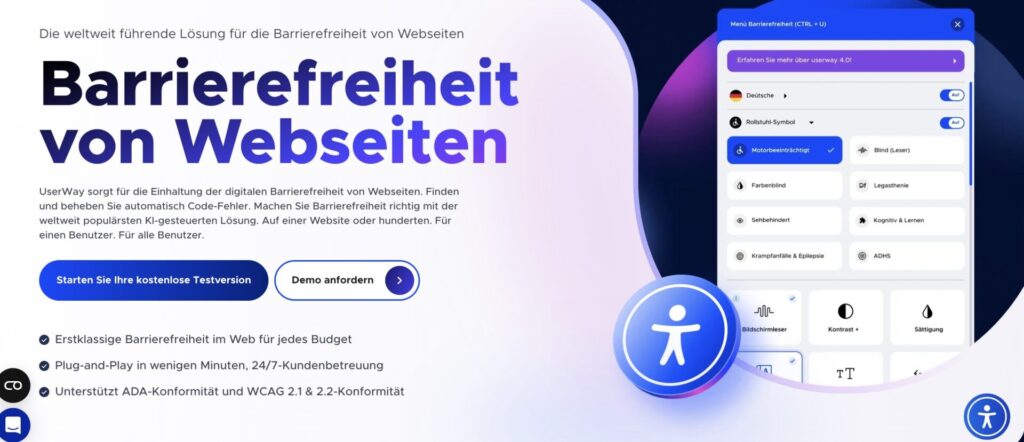
Test the Userway Accessibility Widget
When used wisely, Userway can help improve user-friendliness and perceived accessibility—ideally in combination with structural improvements to layout, HTML, and content.
So what we need to take away from the topic of BFSG:
The Accessibility Enhancement Act 2025 makes it clear: Digital accessibility is no longer an optional extra, but is becoming a mandatory quality standard—especially where people conclude contracts, purchase products, or book services online.
For you as the operator of a website or a BFSG online shops Does that mean:
- Check whether your offers fall within the scope of the BFSG.,
- Ensure that your website is accessible in terms of technology and content.,
- Keep an eye on documentation and information requirements,
- and see accessibility not just as an obligation, but as an opportunity for better user experience, better rankings, and more conversions.
With a solid technical foundation and a clearly structured BFSG Website Checklist With the support of tools—from SEO plugins such as Yoast to accessibility widgets such as Userway—a cumbersome law becomes a practical project that strengthens your digital presence in the long term.
Sources
- Laws on the Internet – Accessibility Enhancement Act (BFSG), Federal Ministry of Justice / juris GmbH, including § 1 (Purpose and scope), § 2 (Definitions), § 14 (Obligations of the service provider), § 37 (Provisions on fines). (Laws on the Internet)
- Laws on the Internet – Ordinance on the Accessibility Enhancement Act (BFSGV), Ordinance on Accessibility Requirements for Products and Services under the BFSG, in particular Sections 1, 2, 12, 13, and 19. (Laws on the Internet)
- Federal Accessibility Agency – FAQs about the BFSG as well as FAQs about services in electronic commerce, Explanation of the products and services affected, definition of „e-commerce services,“ and practical examples of online shops and booking processes. (Federal Agency for Accessibility)
- Federal Ministry of Labor and Social Affairs (BMAS) – Ordinance on the Accessibility Enhancement Act, Background information on the BFSGV and the relationship between the BFSG, BFSGV, and European standards (e.g., EN 301 549). (BMAS)
- Federal Government – „Digital accessibility becomes mandatory: Questions and answers about the Accessibility Enhancement Act“, Compact overview of scope, effective date June 28, 2025, exemptions for micro-enterprises, and examples of application. (Federal Government.de)
- Accessibility Portal (Federal Government) – Information on the BFSG, Overview of the scope of application, market surveillance, and the role of the BFSGV in specifying the technical requirements. (BMAS)
- IHK Darmstadt – „Accessibility Enhancement Act: Mandatory for website operators and online shops“, Classification of BFSG obligations in e-commerce, information on micro-enterprises, B2B offers, and online appointment bookings. (Chamber of Commerce and Industry)
- HÄRTING Attorneys at Law – „The Barrier-Free Accessibility Act (BFSG) in E-Commerce“, Legal analysis of the scope, deadlines, affected online services, and obligations for digital offerings. (HÄRTING Attorneys at Law)
- Legal guide – „Barrier-Free Accessibility Act (BFSG) – What you need to know“, Overview of legal principles, fines of up to €100,000, and examples of information and user interface requirements. (White & Partner Esslingen)
- anatom5 – „BFSG and services in electronic commerce“, Practical classification of BFSG obligations, especially for online shops and service portals, including reference to market surveillance and fines. (Anatom5)
- byte.law – „Accessibility Enhancement Act (BFSG) – New obligations for digital products and services“, Reference to BFSGV and WCAG 2.1 AA as benchmarks for digital accessibility. (Byte.Law)
- European Accessibility Act – Directive (EU) 2019/882, European framework for accessibility requirements, implemented by the BFSG in Germany. (Laws on the Internet)
0 Comments